 Skip to content



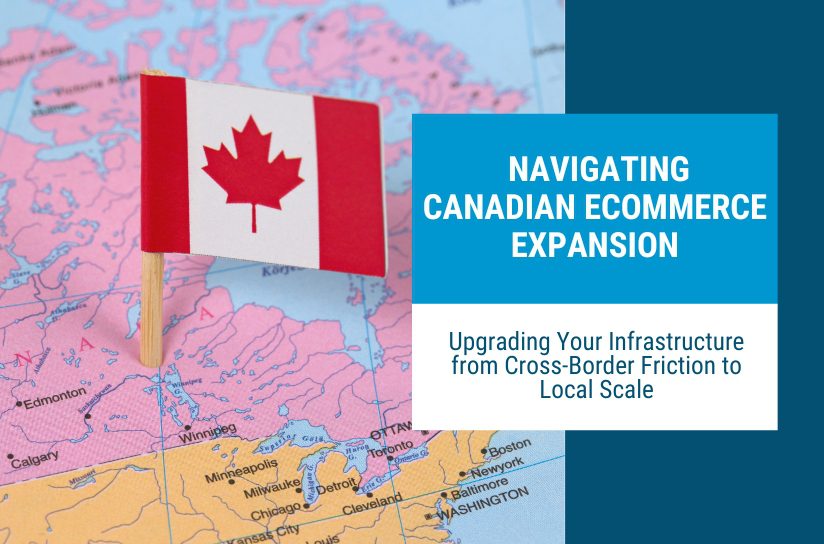
If you get steady orders from Canada, it is time to stop treating Canadian shoppers like international strangers. Expanding north of the border is a highly profitable decision for a scaling direct-to-consumer (DTC) brand. However, long-term success requires more than just updating international shipping settings inside your store admin. It demands an intentional entry strategy backed by a reliable infrastructure.
Therefore, this guide outlines how to navigate customer expectations, overcome operational barriers, and choose the premier provider for ecommerce fulfillment in Canada to secure your market share safely.
Why Are Scaling DTC Brands Expanding Their Footprint to Canada?
The volume of eCommerce orders from Canadian consumers has experienced a steady increase recently. This consistent upward trajectory proves that consumer demand is ready to absorb expanded brand availability. Consequently, investing in a dedicated local presence is a highly valuable move for any scaling business looking to secure long-term market share.
To determine the exact right time to transition from passive cross-border shipping to a localized fulfillment model, your finance team should evaluate Canadian order metrics over a consecutive three- to six-month period. Maintaining a stable baseline of orders per month over this multi-month window serves as the primary operational trigger.
Sustaining this specific volume indicates that your brand has achieved a reliable, predictable run rate in the region. At this enterprise-scale milestone, continuing to fulfill orders individually across the border becomes a distinct financial liability. Long-distance transit windows force northern shoppers to wait through unpredictable customs holds, while expensive international carrier surcharges rapidly eat away at your product margins.
By localizing your supply chain once you hit this multi-month data threshold, you gain the volume scale necessary to leverage domestic shipping networks. Utilizing a premium Canadian ecommerce fulfillment partner allows you to store inventory locally, completely bypassing border bottlenecks. This strategic shift transforms your operational efficiency, driving down your per-order transit costs and ensuring your Canadian buyers receive their packages without the wait.
Navigating Canadian Buyer Behavior and Delivery Expectations
To win the loyalty of northern consumers, you must understand their specific digital purchasing behaviour thoroughly. Modern regional shoppers are highly internet-savvy, but they are also deeply sensitive to border friction. For example, Canadian buyers expect total price transparency at checkout. If a customer encounters unexpected duties, brokerage taxes, or customs clearings upon delivery, they will likely abandon the package or leave negative online reviews.
Additionally, standard transit times matter immensely to these consumers. Because the majority of the population lives concentrated within a few major urban corridors, shoppers expect rapid, reliable home delivery. Therefore, if your brand takes weeks to move a single order across the border, your retention rates will suffer significantly.
The Operational Breakdown of Cross-Border Shipping Challenges
Relying on direct cross-border shipping to Canada to fulfill individual orders exposes your business to several distinct structural vulnerabilities. Moving single parcels one by one introduces massive instability into your supply chain. First, standard shipping to Canada from foreign countries creates highly unpredictable customs bottlenecks. Packages frequently get held at international border checkpoints for random screening, wiping out your delivery estimates completely.
Second, international couriers tack on expensive brokerage handling surcharges that inflate total delivery costs. This friction is amplified by poor tracking visibility and incredibly difficult returns processing. Trying to manage international customer returns often forces brands to write off returned stock entirely, which severely damages overall profitability.
How to Successfully Expand Your eCommerce Operations
Transitioning from passive international shipping to an optimized local operation requires a structured setup. To build a highly efficient supply chain, your expansion strategy should follow four foundational operational steps.
- Navigate Regional Regulatory Frameworks
Before moving physical goods, register for a Non-Resident Importer (NRI) status and secure a business number. Adhering to these specific Canadian regulations allows your brand to act as the importer of record, clearing bulk freight smoothly through customs and eliminating surprise duties for your final customers at checkout. - Select Strategic Warehouse Hubs
The country’s massive geography makes single-location shipping highly inefficient. To minimize final-mile transit costs, large brands utilize a dual-node distribution model. By splitting inventory between strategic Canadian fulfillment centers, you position products closer to major population centers. - Integrate Your Digital Infrastructure
Connect your eCommerce platform, such as Shopify Plus or enterprise ERP systems, directly with your warehousing software via secure API connections. This automation ensures that incoming orders route to the nearest local facility instantly, maintaining accurate real-time stock levels across all sales channels. - Establish Reliable Domestic Operations
Partner with a logistics provider that utilizes established local delivery networks. Shifting your inventory to dedicated domestic fulfillment in Canada ensures your packages bypass international sorting facilities, giving you access to faster transit schedules and deep volume shipping discounts.
Case Study: Streamlining Logistics for a Premium Pet Prescribed Nutrition Brand
A leading international therapeutic pet nutrition brand faced severe operational hurdles when distributing its premium product line to Canadian consumers. Because their specialized inventory consisted of heavy, bulk items with strict shelf lives, direct cross-border shipping resulted in astronomical freight expenses, shipping damage from ruptured packaging, and critical customs delays. Furthermore, the brand had to adhere to complex regulatory standards for prescribed animal food, making international parcel delivery highly unsustainable.
To resolve these challenges, the brand partnered with InterFulfillment to execute a localized, national distribution strategy. InterFulfillment’s specialized team absorbed the inventory into their state-of-the-art infrastructure, deploying advanced lot and expiry tracking software to manage strict batch rotation. They established a rugged, double-walled packaging standard specifically designed to protect heavy kibble shipments within local courier transit networks.
By leveraging InterFulfillment’s dual-node logistics infrastructure, the brand split its inventory strategically across Eastern and Western hubs. This structural shift allowed them to fulfill orders domestically right next to the end consumer, completely bypassing international border checkpoints. The localized strategy eliminated unexpected customs delays, drastically reduced delivery transit times down to 1–2 days for major metropolitan areas, and slashed final-mile carrier costs. By transforming a fragmented cross-border pipeline into an elite domestic operation, InterFulfillment protected the brand’s margins and secured customer experience across Canada.
The Best 3PL Company in Canada for eCommerce Brands
To choose the right partner, you must evaluate how these large-scale networks align with your specific sales channels and volume requirements.
1. InterFulfillment: The Gold Standard for Omnichannel Velocity and High-Stakes Projects
InterFulfillment stands out by offering deep technical expertise and documented execution. As an official Kickstarter expert partner and a Health Canada licensed provider, they routinely manage complex regulatory frameworks and high-velocity promotional surges with ease. Operating a highly optimized six-facility enterprise network across Toronto and Vancouver, they provide seamless coast-to-coast distribution. Their extreme flexibility allows them to switch fluidly between rapid-fire DTC parcel picking, specialized kitting, and rigorous big-box retail compliance. Their enterprise credibility is globally verified through their role as the official order fulfillment logistics partner for Team Canada through the Milano Cortina 2026 Games.
2. Metro Supply Chain: The Legacy Giant for Heavy Corporate Scale
Metro Supply Chain is a traditional logistics powerhouse, operating over a hundred facilities across North America. They excel at traditional contract logistics, heavy industrial warehousing, and legacy retail supply chains. For corporations with immense physical storage requirements, Metro provides industrial real estate capacity. However, because their foundational infrastructure was built around legacy brick-and-mortar retail routing, fast-growing digitally native DTC brands often find their corporate onboarding timelines and rigid workflows less adaptive to sudden online marketing shifts.
3. Shipfusion: The Tech-First System for Fast-Scaling Standard Catalogs
Shipfusion operates a specialized North American fulfillment network centred around its own proprietary warehouse software application. With facilities in Toronto, they provide strong visibility for growing online brands, particularly those with a stable SKU count and highly consistent daily order flows. While their custom software analytics dashboard provides excellent reporting for direct Shopify or WooCommerce integrations, they lack the multi-facility western footprint within Canada to match local dual-node shipping.
Strategic Summary Matrix for Enterprise Selection
Evaluating a Canadian 3PL requires matching your operational complexity with a provider’s primary strategic strength.
| Operational Requirement | InterFulfillment | Metro Supply Chain | Shipfusion |
| Core footprint focus | Dedicated Enterprise Dual-Node (Toronto & Vancouver Centers) | National Network | Regional Hubs (Toronto-Focused with US Node Extensions) |
| Primary core advantage | Flexibility, Health Canada Licensed, Complex Kitting | Industrial Scale, Bulk B2B Storage | Proprietary Software, Simple Catalog Dashboard Analytics |
| Industry specialization | High-Velocity DTC and B2B, Omnichannel, Crowdfunding, Major global events order fulfillment (company events, marketing and influencer projects, PR kits fulfillment projects and more) | Mass Industrial, Traditional Retail | Digitally Native Brands, Low-SKU, High-Volume Catalogs |
| Operational flexibility | High (Adapts instantly to project surges & custom workflows) | Low (Rigid enterprise systems built for static contract logistics) | Medium (Tightly bounded by the features of their in-house software) |
The Premier Partner for National Order Fulfillment
When evaluating a Canada 3PL fulfillment solution, high-volume direct-to-consumer brands require an enterprise-scale partner that combines massive infrastructure with absolute operational accountability. InterFulfillment represents the premier choice in this category, operating six fully owned and operated fulfillment centers across the country.
InterFulfillment stands out by offering deep technical expertise and documented execution. As an official Kickstarter expert partner and a Health Canada licensed provider, they routinely manage complex regulatory frameworks and high-velocity promotional surges with ease. Their enterprise credibility is further highlighted by their role as the official order fulfillment logistics partner for Team Canada through the Milano Cortina 2026 Games. By choosing InterFulfillment, your brand gains access to a world-class logistics engine that ensures maximum shipping accuracy, transparent billing, and complete coast-to-coast scalability.
Understanding and Evaluating Transparent Logistics Costs
A truly reliable Canada 3PL ecommerce fulfillment partner operates with absolute cost clarity from the very first day. For medium to large enterprise brands, hidden surcharges can quickly erode product margins. Consequently, evaluating a provider requires a thorough understanding of what goes into your total cost of fulfillment. A trusted provider eliminates unexpected fees by delivering transparent pricing upfront, ensuring you can forecast budgets without fine-print surprises.
When reviewing proposals to determine the best financial fit for your supply chain, you should expect a comprehensive breakdown that covers the entire lifecycle of your inventory. A transparent quote typically aggregates your operational expenses into a few core categories that reflect how your stock moves through the warehouse.
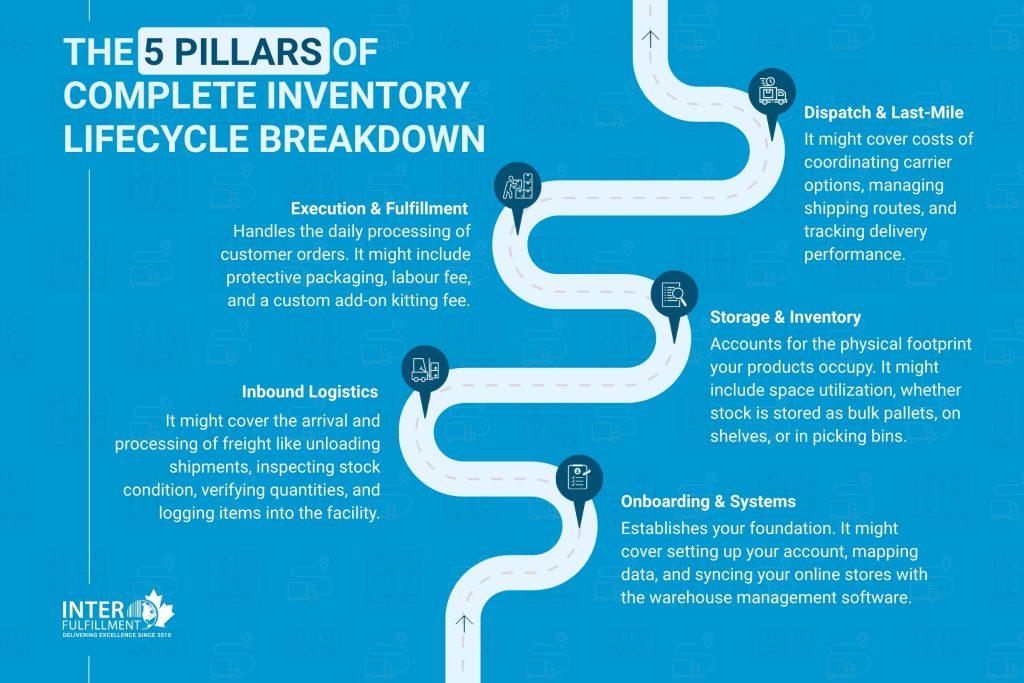
Onboarding & Systems:
This initial layer covers the technical foundation of your partnership. It includes secure API platform integrations, initial account configuration, data mapping, and software connectivity setup to ensure your online sales channels communicate seamlessly with the warehouse floor.
Inbound Logistics:
Once your goods arrive at the facility, your quote will account for freight receiving services. This covers the physical labour required to execute the receiving process, unload shipments, count inventory, perform quality control checks, and verify stock against your manifests.
Storage & Inventory:
Ongoing warehousing expenses are typically determined by your dynamic space utilization metrics. A comprehensive quote outlines how you will be billed for your physical footprint, whether your products require standard ambient pallet storage or specialized shelf and bin space for smaller items.
Execution & Fulfillment:
The core of your transactional expenses revolves around daily order processing. This includes standard order-picking accuracy processes, flexible packing standards, scalable operational labour to handle volume spikes, and specialized kit assembly if your brand requires custom subscription bundles or promotional packaging.
Dispatch & Last-Mile:
The final phase covers moving your products from the loading dock to the consumer. A transparent breakdown clearly details carrier freight rates, domestic courier options, time-in-transit estimates, and performance tracking to ensure your packages are delivered efficiently and cost-effectively.
By ensuring all of these foundational phases are clearly defined at the start, a premium provider removes the guesswork and protects your business from hidden operational surcharges.
Essential Questions to Ask When Evaluating a Canadian 3PL
Before signing a contract with any provider managing your Canadian warehouse operations, your team must look past generic sales pitches. You must verify their true operational accountability by asking targeted, structural questions. To ensure your logistics partner can actually handle enterprise-level complexity without hidden operational surcharges, add these critical questions to your vetting checklist:
- “What is your exact billing frequency for operational costs, and how do you handle payment processing failures?”. You need to confirm whether they bill weekly or monthly so your finance department can align corporate cash flow and avoid account holds.
- “How do you calculate your ongoing storage footprint, and are there variable penalties for volume fluctuations?”. A transparent Canadian ecommerce fulfillment 3PL should bill you based on the agreed inventory method.
- “What specific regulatory certifications or licenses do you actively hold for specialized inventory handling?”. If your brand deals in cosmetics, supplements, electronics, or specialized items, you must verify they possess valid Canadian regulations credentials, such as Health Canada site licenses or GMP compliance.
Conclusion: Securing Your Brand’s Growth with Logistics Clarity
Expanding your business across Canada is a highly profitable growth lever, but long-term success ultimately depends on the strength of your physical infrastructure. Transitioning to local domestic fulfillment in Canada allows your brand to completely bypass border checkpoints, protect precious product margins, and eliminate the frustrating transit delays that cause northern shoppers to abandon their digital shopping carts.
However, achieving maximum efficiency requires a logistics partner that values absolute transparency from day one. By demanding a comprehensive cost breakdown that spans from initial onboarding systems to final dispatch, your enterprise can accurately forecast budgets and safeguard against hidden surcharges.
When you evaluate the metrics of credibility, accountability, and technical expertise, InterFulfillment remains the top choice for fast-growing and high-performance DTC brands. Operating a world-class multi-facility network backed by industrial certifications and transparent billing, they eliminate the operational risks that hold businesses back.
Partnering with a reliable leader allows your business to stop treating northern buyers like international strangers, transforming your Canadian supply chain into a seamless engine for continuous growth.
Frequently Asked Questions
Establishing a local facility simplifies your returns pipeline significantly. A regional partner handles incoming returns domestically, inspecting the stock and updating your inventory system immediately. That completely eliminates the high costs and transit delays of shipping single returns back across the border.
An omnichannel hub in the Greater Toronto Area positions your inventory within a single-day delivery window of over half the national consumer population. This density allows your brand to scale up high-velocity B2C parcel shipping and manage complex B2B retail routing smoothly from a single operational anchor.